BDSM Terms Explained: A Plain-Language Glossary

Short answer: BDSM is an umbrella term for consensual play that involves restraint, power exchange, sensation and role-taking between adults. This glossary defines the most common terms in plain language, one sentence each, so you can follow a conversation, read a product page or talk to a partner with confidence.
By KBD Editorial. Reviewed by the KBD team for accuracy, November 2026.
Key points
- BDSM stands for bondage and discipline, dominance and submission, and sadism and masochism. In everyday use it covers a wide range of practices, from very light to intense.
- Almost every term below rests on one idea: everything is agreed beforehand, and anyone can stop at any time.
- You do not need to use any of these words to explore. They are there to make talking easier.
- Definitions vary between communities. Where they do, we give the most common use.
What does BDSM mean, and where do you start?
BDSM is a set of practices between consenting adults, covering bondage, discipline, dominance, submission and sensation. Most couples who are curious start with something simple, such as a blindfold or a soft restraint, and build from there at their own pace.
The terms below are grouped alphabetically. Each links to a fuller guide where one exists. If you are reading with a partner, you do not have to agree on every definition: the point is to find a shared language for the two of you.
What do aftercare, bondage and consent mean?
Aftercare is the care partners give each other after a scene, bondage is any agreed restriction of movement, and consent is a free, informed agreement that can be withdrawn at any time. Here are those and the other common terms from A to C.
- Aftercare
- The time after a scene when partners check in, rest, share water and warmth and reconnect. Read more in our aftercare guide.
- BDSM
- An umbrella term for bondage, discipline, dominance, submission, sadism and masochism, used for consensual practices between adults.
- Bondage
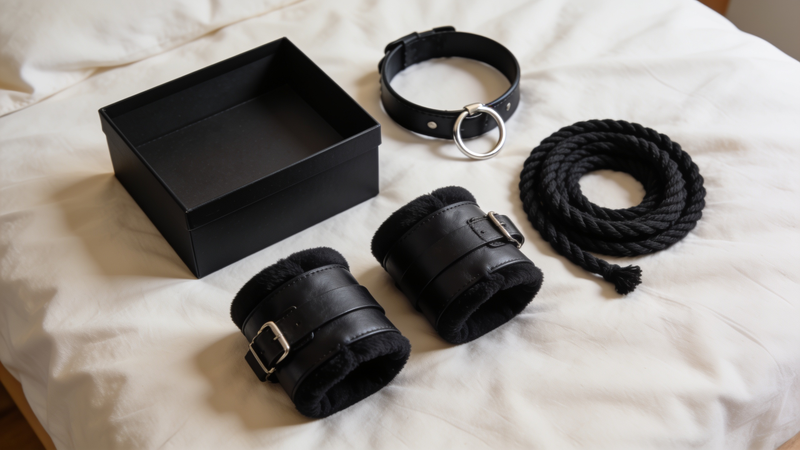
- Restricting movement using cuffs, rope, tape, jackets or similar tools, always by agreement.
- Bottom
- The person who receives the action in a scene, as opposed to the person directing it. Being the bottom says nothing about who holds the real control, since the bottom can end the scene at any time.
- Check-in
- A brief question during a scene, such as "how does that feel?", to confirm that the other person is comfortable.
- Collar
- A band worn at the neck as a sign of a role or commitment, or simply as an accessory. A collar should never press on the throat.
- Consent
- A clear, freely given, informed agreement that can be withdrawn at any time. See the NCSF's Consent Counts resources for more on consent in this community.
What do dominant, hard limit and kink mean?
A dominant is the person who leads a scene by agreement, a hard limit is something a person will never do, and kink is a broad word for interests outside convention. The D to L terms follow.
- D-ring
- A D-shaped metal ring on a collar, jacket or cuff, used as an attachment point. The Half Jacket's centre strap ends in one.
- Dominant (Dom)
- The person who takes the lead in a scene, by prior agreement. It describes a role, not a personality.
- Hard limit
- Something you will not do under any circumstances, and something nobody should pressure you to reconsider.
- Impact play
- Sensation play using hands, paddles or soft whips, always agreed in advance. Our impact play guide is a gentle introduction.
- Kink
- A broad word for interests outside conventional norms, including bondage, role-play and sensory play.
- Limits
- The boundaries each person sets before a scene: what they will do, might do and will not do.
What do negotiation, power exchange and restraint mean?
Negotiation is the talk before a scene, power exchange is an agreement that one person leads and the other follows, and restraint is anything that limits movement. These and the other terms from N to R are below.
- Negotiation
- The conversation before a scene where you agree what will happen, what will not and how you will signal if something changes.
- O-ring
- A round metal ring used as an attachment point. The Bondage Jacket's collar has a large one.
- Power exchange
- An agreement in which one person takes the lead and another follows, for a scene or a longer period. It is always consensual and can be ended.
- Quick release
- A closure designed to open fast, even under tension, such as a panic snap. Ordinary buckles are not quick-release, which is one reason to keep safety shears within reach.
- Restraint
- Anything that limits movement, from soft cuffs to a full jacket. Our restraint play guide covers the basics.
- Role-play
- Acting out a character or scenario by agreement, from teacher and student to something entirely invented.
What do safeword, scene, top and switch mean?
A safeword stops a scene at once, a scene is a planned period of play, a top directs the action and a switch enjoys both leading and following. The remaining terms, S to Z, are here.
- Safe, sane and consensual (SSC)
- A long-standing guideline for play: it should be as safe as possible, undertaken with a clear mind and agreed by everyone.
- Safety shears
- Blunt-tipped scissors kept nearby to cut a strap or rope quickly if a buckle jams or a knot will not release.
- Safeword
- A pre-agreed word that stops a scene immediately, no questions asked. Our safewords guide explains how to pick one.
- Scene
- A planned period of play, with a beginning, an end and agreed activities. See building a scene.
- Sensory play
- Play that changes what you feel, see or hear, such as a blindfold, a feather or a change in temperature.
- Sleepsack
- A garment or bag that encloses the whole body, from the shoulders to the feet. It restricts movement far more than a jacket and needs close supervision.
- Soft limit
- Something you are unsure about, and might try in the right context with a partner you trust.
- Straitjacket-style jacket
- A restraint jacket whose long sleeves are closed at the ends and fasten across the body. The bondage jackets collection shows ours.
- Submissive (sub)
- The person who follows the lead in a scene, by agreement. Like the dominant role, it describes a role in the scene.
- Switch
- A person who enjoys both leading and following, sometimes in the same evening.
- Top
- The person who directs or performs the action in a scene. Like the bottom, a top is still bound by every limit the other person has set.
- Traffic-light system
- A simple signal scheme: green means keep going, yellow means slow down or check, and red means stop immediately.
- Yes/no/maybe list
- A worksheet where each partner privately rates activities as yes, no or maybe, then compares the answers. It is a good way to start a conversation without putting anyone on the spot.
How do you use these terms with a partner?
Use them as a shorthand, not a script. A shared vocabulary makes planning quicker and misunderstandings rarer, and nothing here obliges you to adopt anyone else's labels. Many couples find that agreeing on a handful of words, such as a stop word, a colour system and a way of saying "slower", is enough.
If a term makes one of you uneasy, say so and skip it. The aim is to build trust, and the vocabulary should support that. Talking through a short list of definitions before you start can itself be a useful warm-up, since it gets the awkward part out of the way.
Questions
Is BDSM only about restraint?
No. Restraint is one part. Others include sensory play, role-play, power exchange and impact. Many couples explore only one or two of these and never need the rest.
What is the difference between a dominant and a top?
A dominant takes a leading role through agreed power exchange. A top performs an action in a scene. The two overlap but are not identical, and a person can be one without the other.
Do I need to pick a label?
No. Labels are optional and can change. Some people use none at all.
Where does a restraint jacket fit in?
It is a restraint tool, used in a scene that you and your partner have negotiated. Cropped styles are lighter and quicker to remove, and full-length styles hold more firmly.
Shop the piece
 Half Jacket4.7 out of 5 stars, (650 reviews)$84.98
Upper-body restraint in leathery PU that holds the arms behind the back. Sizes S and M.
Shop the Half Jacket →
 Bondage Jacket4.7 out of 5 stars, (650 reviews)$89.25
Full-coverage restraint jacket in leathery PU: black, white, pink or red.
Shop the Bondage Jacket →
Starting with accessories? Try the Beginner's Bondage Kit (10 Piece) or browse all kits.